Categories
Uncategorized

Self- Assessment Essay Reflection

Throughout this creative expression course, I had to meet the criteria for this class in terms of writing, analyzing and processing the information I am listening, reading, and watching, being able to think critically about them and then synthesizing it and creating oral and written arguments/responses. Moreover, I was supposed to articulate how meaning is created in the arts, identifying and applying the fundamental concepts of interdisciplinary field, and lastly analyzing how arts from diverse cultures of the past serve as a foundation for those present. Some goals the class has provided for me are developing college-level  work and being able to collaborate with my peers and teachers. I personally believe I met all of the criteria for this class and the goals for the FIQWS class did help me get adjusted to college life. I feel like I became a stronger and better writer, while also helping me analyze and understand which information can benefit me the most in my writing and in the arguments I’m creating and trying to support. This class helped me feel college ready from assignments to collaborating with peers  because I was able to listen and talk to multiple different people and see how they did their work. This helped me better my own work and see what I was lacking in my own paper better. . Overall, I think this class helped me grow not only as a writer, but also being able to express myself creatively by learning and writing about topics I thoroughly enjoy. 

The first major essay/assignment done in this class was the Artifact Analysis essay. In this assignment, we had to choose one of the plays/songs that we had worked on in the topic component of the class and choose a specific element of the play/song and analyze it. I chose to do the song “Snow” from the play “Clouds Are Pillows for the Moon” by Ty Defoe and Tidtaya Sinutoke. An element from the song that I chose to focus on were the actors singing and movement while performing these characters and how it showed the difference between the girl from Thailand and the girl from New York. I think this essay went really well for me and was a good introduction to the work we would be doing throughout the whole course as well. I was able to analyze the parts of the song that I thought were key to bringing the meaning of the song together. I used specific quotes and explained the body movements thoroughly in the essay. I think this essay also helped me be more descriptive in terms of my analysis, because like I mentioned before I had to explain the body movements in a way where if someone who has never watched or heard “Snow” can envision and imagine it. I never have done something like this before, being so descriptive of body movements, but I think I did good for my first time trying it. Using the specific quotes from the song though was something I have done before, so for me that was the easiest part because it was something so familiar. I think the hardest part for me was trying to summarize the whole song. I had never written an essay based off of a video clip, mostly just articles and books, so it was hard for me to constantly have to replay the video and really try to focus on their body movements and how they express themselves while they sing. Other than that, I think the rest of the essay process went pretty smoothly for me and I actually enjoyed writing this essay and comparing and contrasting the two characters. 

The second major assignment for this course was the Genre Translation Project. For this assignment, we had to choose one of the plays/songs that we had been introduced to in the topic component of this course and make a creative project based off of it requiring a writing portion. The song I chose for this project was “Snow” by Ty Defoe and Tidtaya Sinutoke. At first, I had only made a vision board as if I was the girl from Thailand getting ready for her trip to New York to finally see the snow with a writing piece attached to it about why I chose to do a vision board for this character. I thought that this counted as the text element but my professor said that it didn’t, so I had to find another way to incorporate a text element in a creative way that goes hand in hand with my vision board. I could have not used it, but I felt really strongly about my vision board and I genuinely liked it. I had fun creating it, so I decided to do a journal entry as the girl from Thailand. The way I incorporated the vision board I created into the new journal entry that I created was referencing the vision board in the journal. I know a lot of people on social media do vision boards for their trip, which is why I even made one in the first place, but I wanted to further show the girl from Thailand’s excitement for wanting to see the snow by making the journal entry six months before she even goes abroad. I feel like I captured this in the journal entry by trying to keep a tone of excitement in the entry and also reference some of the actual lyrics from the song. Overall, I think I did a pretty good job at this assignment, I just needed to add that text element that I was missing in the beginning. This creative assignment was fun for me as well. I never really enjoyed creative projects like these because they were always really time consuming, but this one was not only simple, but I actually got to put myself in the character’s shoes and try to emulate them, which I had never done before. 

The final major assignment for this course was a research essay about something in the performing arts and write a 5-7 page essay based on it using at least 5 outside sources and citing them in MLA format. The type of performing arts I chose was music, specifically reggaeton music. I wanted to research how reggae music influenced and impacted what reggaeton is today. I wrote about the beginnings of reggaeton and how reggae contributed to it, then I started to talk about the foundation of the music rhythm wise, next, I talked about how/when it got popular, its cultural impact, and how it differs from reggae. This was my favorite writing piece by far. I got to write about a topic that is a big part of my culture and one that I’ve loved all my life. It helped me learn a lot about my culture and also its roots. I think the hardest part for me for this essay was putting everything in MLA format because I used a lot of different sources to back me up, and some of them I had to really search for the authors and specific dates. Other than that, I think it was good. My choice of articles helped me a lot. They were all filled with a lot of information that helped me write my article to the point where I never felt stuck writing a specific piece because I knew I had a lot of articles and evidence to back up what I was saying. I also feel like I was able to interpret the information I was getting to truly support my topic while also giving context so that if someone doesn’t really know what reggaeton is or even the basics, I feel like I was able to analyze my quotes well and show my understanding of my quotes throughout the articles.I think my choice of articles helped me alot. They were all filled with a lot of information that helped me write my article to the point where I never felt stuck writing a specific piece because I knew I had a lot of articles and evidence to back up what I was saying. 

In conclusion, I enjoyed this class more than I expected. I was able to explore new mediums of writing in the Genre Translation project and also write about a topic that means so much to me. I was also able to do things that I was already familiar with like in the Artifact Essay. I think this class helped me a lot in terms of making my writing stronger while also becoming more creative and intentional with it. So far my favorite project this semester has to be the research paper, it meant a lot to me culturally, and also helped me learn how to write a research paper using so many different sources. My least favorite, even though I liked all of them to some extent, was the Artifact essay. It was a generic essay but it really helped with that transition of writing essays in high school, to writing a college level essay. Overall, I think this class was very helpful and can be helpful for freshmen. It helps you get more comfortable with college level writing and also have some creative freedom based on what you learn in this class.  
Categories
Uncategorized

Reggae’s Influence on Reggaeton (Research Essay)

In the Latin community, there was a major shift in music genres in the 1990s and 2000s. The most popular genres at the time were salsa, merengue, and bachata. This genre is called reggaeton. The genre was created in the 1980s by Jamaicans who migrated to Panama and brought reggae and dancehall music that eventually created the “Dem Bow” song and beat, which is one of the foundations of reggaeton. This style of music migrated to the rest of the Spanish-speaking islands of the Caribbean and skyrocketed with artists like Daddy Yankee, Don Omar, Ivy Queen, and many more. In reggaeton, its origins in reggae and dancehall are very prevalent in the rhythm of the music, a wide range of lyrical topics, from social and political topics to love and party life. Lastly, the big cultural impact the music has, in this case, on the Latin community. Although Reggaeton does get its start from Jamaican music, it differentiates itself usually with a faster tempo and the obvious Spanish language being used in the songs.

The beginnings of reggaeton were in Panama, although there are many debates over this. Because of the large migration of Jamaicans to the country to build the Panama Canal, reggaeton eventually emerged. Panamanian Reggae was on the rise in the country in the 1970s – 80s, as Jack Lasky states in the EBSCO article he wrote called “Reggaeton”, “…many Afro-Panamanian DJs began crafting Spanish-language versions of Jamaican reggae songs. While the DJs behind these covers initially reproduced the rhythms and sounds of the original songs as closely as possible, some gradually began altering them with the addition of Latin rhythms.” As a result of the Panamanian DJs, like the most influential reggaeton rapper, El General, adding the Latin rhythms to their reggae and dancehall songs, this eventually “evolved” into the sound of reggaeton that was heard in the 1990s. 

The rhythmic foundation of reggaeton that can be found in any song is a “Dem Bow” beat. Its roots come from Jamaican “riddim”, which is the Jamaican patois word for “rhythm”. It refers to the instrumental back track of the song that created the foundation for reggae and dancehall. These backtracks are often reused by different artists as well. The Dem Bow beat is considered a riddim. As noted by Bryan Pyers in his article “Dembow Explained (+ 19 Songs Featuring The Iconic Rythm)” he states that being made by Jamaican producers Steely and Clevie in the song “Poco Man Jam” for musician Greogy Peck in 1989. The song that globalized the beat was in  Shabba Ranks’s song “Dem Bow” in 1990/91. The riddim was produced by Steely and Clevie but also by Bobby “Digital” Dixon. According to “Dem Bow, Dembow, Dembo: Translation and Transition In Reggaeton” by Wayne Marshall, he explains that these producers took “the standard dancehall beat pattern and adds extra snare rolls to give it more of a distinctive shape,…’’ Moreover, the riddim has a “prominent, driving bassline and occasional chords, played on a keyboard and often “dubbed out” through the application of heavy echo/delay.” 

Reggaeton Beat.mp4 (Marshall)

This image and audio by Wayne Marshall in his article “Música Negra to Reggaeton Latino” represents the classic dembow riddim created by Steely and Clevie. It’s the basis of the reggaeton beat heard today. 

The riddim from the song “Dem Bow” is the most popular seen in a lot of Panamanian reggae and reggaeton songs. When the song “Dem Bow” touched down in Panama, a lot of Panamanian Reggae artists were taking the song and translating it from English and Jamaican patois to Spanish. These songs being “Ellos Benia” by Nando Boom and “Son Bow” by El General.

Reggaeton as we know it now truly evolved in Puerto Rico in the 1990s. With the reggae in Spanish spreading to the Caribbean in the 90s, rap and hip-hop music, which were created in the Bronx, New York, were also spreading with the help of the pioneer of rap in Puerto Rico, Vico C. With these two genres being fairly popular, they started to as Alicja Zelazko, the author of the article on reggaeton published on Britannica, “By the 1990s, both hip-hop in Spanish and reggae en español had converged on the island, forming a type of music called underground.” Underground, later called reggaeton, was created primarily in the nightclubs of Puerto Rico, most notably The Noise, created by a DJ by the name of DJ Negro. In this nightclub, Zelazko states, “ …reggaeton performers tested their talents.” In these songs, although they had heavy themes and lyrics of homophobia, misogyny, and sex, in Zelazko’s words, “…addressed racism and life in the caseríos, the low-income housing projects on the island. Indeed, during the 1990s underground singers and listeners, many of whom lived in the caseríos, were targeted as drug dealers and other criminals during the government’s anti-crime campaign, Mano Dura Contra el Crimen.” This made the popularity of the genre rise because a lot of the people of Puerto Rico could relate to the struggles and hardships mentioned in these songs. This made them have an escape from their daily life while also being able to speak out and in their own way protest against their living conditions, it was their form of resistance. This same sentiment can be seen in the article, “Wellesley Professor Explains the Rise of Reggaeton in North American Pop.” Professor Petra Rivera-Rideau states, “But when you look at things like who has access to education, or at housing segregation, it’s very clear Afro-Puerto Ricans are discriminated against. Reggaeton provided a space to talk about those issues.” This idea of providing a space to talk about the issues that are faced in these communities isn’t a new one and comes from the roots of Jamaican Reggae and Spanish Reggae, which ties the two genres together, and its roots in reggaeton at the height of its conception. 

In the year 2004, reggaeton was having its big breakthrough with Tego Calderon’s El Enemy de los Guasabíri, who talked about social issues and politics, Real by Ivy Queen, which was about love and heartbreak, but most importantly Barrio Fino by Daddy Yankee, that had songs ranging from urban life, to party songs about love, and sex. The song that blew up the most from this album was the song “Gasolina.” In an EBSCO article called “Reggaeton” written by Jack Lasky, he states, “All of these releases proved to be popular hits that laid the groundwork for reggaeton’s emergence as a legitimate musical genre with a reach that extended well beyond Latin America.” As a result of this, more reggaeton acts started to become more famous and recognized as well like Wisin y Yandel with their hit “Rakata” in 2006 and were the first reggaeton act to receive a Grammy in 2009 for their album Los Extraterrestres Best Latin Urban Album according to Jack Lasky in his article “Reggaeton”. In the 2010’s was the rise of the digital age, these songs started to be put on Pandora, Spotify, Apple Music, etc, which made reggaeton all the more accessible worldwide. One of the most popular songs to come out of that era is “Despacito” by Luis Fonsi and Daddy Yankee in 2017 with another version being released with Justin Bieber. The duo got to perform this in the 2018 Grammy Award Ceremony (Lasky). This song really put reggaeton on the map, not only in the U.S. and Latin America like the songs and albums mentioned before, but globally. There wasn’t a moment in time where this song wasn’t playing from the years 2017-2018. This moment in reggaeton’s history led to more artists to come up now, like Bad Bunny who was inspired by pioneers of the genre like Daddy Yankee and Tego Calderon, Karol G, Young Miko, Rauw Alejandro, J Balvin, and many more. 

Reggaeton has become the most prevalent music genre for Latin American, especially the youth. Its cultural impact is undeniable, both economically and socially. According to the article “Reggaeton’s Global Impact Empowering Latin America” by Kailey Schwinghammer, she states, “Latin music revenue in the U.S. soared to $1.1 billion in 2022, with a remarkable 24% annual increase, outpacing other markets.” The constant demand for reggaeton is on the rise, “…Streaming revenues, accounting for 97% of Latin music earnings,…” This helps generate many countries who are famous for reggaeton and produce the majority of it like Puerto Rico, Colombia, and the U.S. and more get a good amount of money that goes towards their economy. The author even goes on to say that this economic boom is “…fueled significantly by Bad Bunny’s chart-topping albums. The importance of this revenue lies outside of the United States, where artists and fans in Latin America are fueling economic growth.” Because of Bad Bunny’s popularity globally, his music is putting more reggaeton on the map. He is also impacting the Latin American community socially as well. Reggaeton’s roots have always had activism, which was taken from its roots in reggae. What Bad Bunny is doing with his music is “shedding light on pressing issues.” As Kailey Schwinghammer states. A direct example can be in his song “El Apagón” from his 2022 album Un Verano Sin Ti. This song talks about the constant blackouts in Puerto Rico, where he was born and raised, and the gentrification of the island. He criticizes the government not taking into account its residents, and the constant privatization of public resources which negatively impacts the Puerto Rican people. This song helped shed light to an issue some people didn’t even know that was happening in Puerto Rico. Moreover, this issue resonates not only in Puerto Rico, but also a lot of different Latin American countries that are going through the same thing. This gives the people impacted a bigger platform to talk about the issues they are facing at a global level because now everyone who consumes reggaeton, more specifically Bad Bunny’s music, can advocate for change.

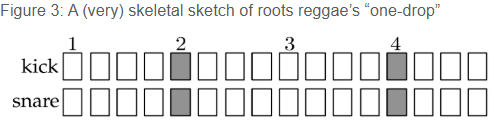
Although Reggaeton does get its start from Jamaican music, it differentiates itself usually with a faster tempo and the obvious Spanish language being used in the songs. In the article “Reggae vs. Reggaeton: What’s The Difference?” by Corey Walles, he goes over the differences of Reggae and Reggaeton. One of the major differences between the two genres is the language. Reggae primarily uses Jamaican patois in their songs, while reggaeton uses Spanish. Mostly Caribbean Spanish, which differs from Spanish heard in other Latin American countries.  Walles states, “The musical style of reggae is distinct, defined by its slow tempo, syncopated rhythm, and deep bass lines. Known as the “one-drop” rhythm, reggae emphasizes the second and fourth beats, often creating a laid-back yet dynamic sound that’s instantly recognizable.” 

Screen Recording 2025-11-30 223431.mp4 (Marshall)

This image and audio by Wayne Marshall in his article “Música Negra to Reggaeton Latino” demonstrates what Corey Walles is talking about when he refers to the “one-drop” rhythm. The image represents the emphasis on the second and fourths beats as well, only the kick and snare have the actual beat on it. Moreover, reggae uses and “heavily relies on” as Walles mentions, “instruments like bass guitar, drums, and rhythmic off-beats that capture its soulful, earthy vibe.” While the vocals have a “melodic” sound to them. All of this contributes to the overall sound of reggae and the spirituality seen in these songs, which go over lyrical topics such as one’s faith, resistance to oppression, and social issues. Reggaeton musical characteristics are directly derived from the “dembow” rhythm (See page 2 of essay to see and hear the “dembow” rhythm). Walles describes this as “a repeated pattern that drives the genre’s infectious energy. This genre is marked by synthesized sounds, drum machines, and electronic basslines, which lend reggaeton a modern, club-oriented feel.” Reggaeton relies on electronic and hip hop sounds in the songs, while the vocals feature “same voice melodies and repetitive hooks, emphasizing rhythm over melody to get people dancing.” Reggaeton also mixes in other Latin musical genres like bachata, merengue and salsa. While reggae has a more “laid-back” feel to them, reggaeton usually makes people want to dance, using fast paced electronic and hip-hop beats and rhythms. 

To conclude, to truly understand the history of any musical genre, we have to look at what directly influenced and impacted the musical genre first, and then see how it evolved over time. This can directly be seen with reggaeton and its beginnings being rooted in reggae and dancehall music.  This can be seen in the rhythm of the music, a wide range of lyrical topics, from social and political topics to love and party life. Lastly, the big cultural impact the music has, in this case, on the Latin community. As reggaeton evolved, it differentiated itself usually with a faster tempo and the obvious Spanish language being used in the songs.

Works Cited

Dubmatix. “How Shabba & The “Dembow” Riddim Launched Reggaeton.” Bass Culture Music Magazine, https://bassculture.substack.com/p/how-shabba-and-the-dembow-riddim.

Flynn, Grace. “Reggaetón: Origin and Evolution of a Genre.” Marquette Wire, 28 November 2021, https://marquettewire.org/4065685/radio/reggaeton-origin-and-evolution-of-a-genre/. Accessed 30 November 2025.

Lasky, Jack. “Reggaeton | Research Starters.” EBSCO, 2023, https://www.ebsco.com/research-starters/music/reggaeton. Accessed 30 November 2025.

Marshall, Wayne. “Música Negra to Reggaeton Latino.” Wayne & Wax, https://wayneandwax.com/?page_id=139.

Parys, Bryan, and Wayne Marshall. “Dembow Explained (+19 Songs Featuring the Iconic Rhythm).” Berklee, 18 March 2024, https://www.berklee.edu/berklee-now/news/what-is-dembow-tracing-the-roots-of-a-global-phenomenon. Accessed 30 November 2025.

Rivera-Rideau, Petra R. “Reggaetón.” Oxford Bibliographies, Oxford Bibliographies, 23 March 2023, https://www.oxfordbibliographies.com/display/document/obo-9780199913701/obo-9780199913701-0123.xml.

Schwinghammer, Kailey. “Reggaeton’s Global Impact Empowering Latin America.” The Borgen Project, 4 December 2023, https://borgenproject.org/reggaetons-global-impact/. Accessed 30 November 2025.

Walles, Corey. “Reggae vs Reggaeton: What’s The Difference?” Sound Like Corey, 12 November 2024, https://soundslikecorey.com/reggae-vs-reggaeton/#:~:text=Reggae%20hails%20from%20Jamaica%2C%20with%20roots%20in,merging%20hip%20hop%2C%20dancehall%2C%20and%20Latin%20sounds.

“Wellesley Professor Explains the Rise of Reggaeton in North American Pop.” Wellesley College, 2017, https://www1.wellesley.edu/news/2017/stories/node/118491.

Zelazko, Alicja, and Gerard Béhague. “Reggaeton | Music, Artists, History, & Facts.” Britannica, 24 October 2025, https://www.britannica.com/art/reggaeton. Accessed 30 November 2025.

Bilby, Kenneth, and Ken Bilby. “Reggaeton.” World of Music, vol. 1, no. 1, Verlag für Wissenschaft und Bildung, 2012, pp. 149–51. (Parys and Marshall)

Parys, Bryan, and Wayne Marshall. “Dembow Explained (+19 Songs Featuring the Iconic Rhythm).” Berklee College of Music, 18 March 2024, https://www.berklee.edu/berklee-now/news/what-is-dembow-tracing-the-roots-of-a-global-phenomenon. Accessed 18 November 2025.

Categories
Uncategorized

Genre Translation Project

Diary Entry and Vision Board for “Snow” by Tidtaya Sinutoke and Ty Defoe based on the girl from Thailand

March 24, 20XX

Friday

5:00 pm

Dear Diary,

In 6 months, I’ll be going to the United States!!! Specifically, the North. I know I’m going as an exchange student and I need to focus on my studies, but…. I can’t wait to see the snow!!!! Honestly, the only reason why I chose to go over there was. It’s so hot and humid here in Thailand, the never ending heat gets tiring, you know? It’s all I’ve ever seen and experienced my whole life, and I’m about to go broke spending all my money at Dream World just to Snow Town and see the “snow”. 

To prepare myself for this trip, I decided to create a vision board and list all the things I’m going to do. I can’t wait to play in the white blankets of snow that’ll cover the ground completely! I want to run, skip in the snow; I even want to lick it!  I’ll have to wait for it to fall out of the sky. How will it fall out of the sky?  Is it pillowy and soft? Is it clean and sparkling? Will it fall out of the sky like ping, ping, ping? I can’t wait!!! I’d definitely have to ask someone who has experience with snow before what it feels like, and hopefully, I can become close to them! I’m going to stop this entry here. I have to go looking for winter clothes!

_Snow_ Vision Board (1) (1)

Categories
Uncategorized

Analysis on “Snow” (Essay + Oral Presentation)

The song “Snow” by Ty Defoe and Tidtaya Sinutoke, from their piece titled “Clouds are Pillows for the Moon,” is about how two girls, one an exchange student from Thailand and the other from New York, are complete opposites. From their personalities to their upbringings. This can be seen through their singing and movement while performing these songs. The girl from Thailand has a brighter tone, with bubbly and energetic body movements, while also showcasing her strong desire of wanting to see snow. The girl from New York has a deeper voice and moves more stoically and seriously while also mocking the girl from Thailand’s attitude about the snow. They come together through the girl from Thailand’s excitement about the snow, even reminding the girl from New York of a core memory she had with the snow. In the end, they were able to share their love of snow, even if it took some warming up for the girl from New York, and were able to form a friendship.


While performing “Snow,” the girl from Thailand in the beginning explains to the girl from New York why she chose to be an exchange student, which was because she wanted to experience snow since she was never able to due to the hot climate of her country. When describing what she’d do in the snow, she says, “So I bring out my umbrella, and pretend I’m Cinderella, waiting for a blizzard to come by!” While saying this, she gestures as if she’s actually bringing out an umbrella and holding it above her head with a big smile on her face. Not only does she showcase her excitement for the snow, but also her curious nature. Moreover, her reference to Cinderella, a storybook/fantasy princess, gives her description of the snow (which she’s never seen or felt before) a magical feel to the whole experience. While singing this line, she has a bright tone that stays in a higher pitch and upbeat throughout, like she was spreading her joy to the audience. In response to this, the girl from New York calls her “weird” and states matter-of-factly, “You don’t wait, it just comes.” The girl from New York has a deeper tone to her voice, one that is the complete opposite of how the girl from Thailand was singing just a moment ago. While singing this part, the girl from New York looks at the girl from Thailand in disbelief, smiling, and moves her arms and hands at the fact that she could be so naive and not know a thing about snow. This interaction gives the audience a sense of the girls’ relationship throughout the song.
Throughout the rest of the song, the girl from Thailand talks about how excited she is to see the snow and actually experience it. The girl from Thailand makes big movements when she describes what she would like to do in the snow, like dancing in it, licking it, and throwing it. The girl from New York maintains a tone and smile of disbelief in what the girl from Thailand is saying about the snow and tells her the harsh truth about the snow. The girl from Thailand always replies with the word “Awesome” after each time she learns something new, even if the way she is told the information is rude and cold. This repetition demonstrates the genuine love the girl from Thailand has for the snow and also how desperate to see it because she doesn’t let the girl from New York change her love for the snow, but instead takes it as a learning opportunity.


Near the end of the song, the girl from Thailand asks a question about the girl from New York being “Do you like the snow?” This question makes the girl from New York hesitate a bit, but she responds with, “Sure.” The girl from Thailand is persistent, asking her what she likes about the snow while grabbing her hand, which persuades the girl from New York to answer more specifically. “It’s, I don’t know, one time my nina and I poured maple syrup on the snow.” While saying this line, she fiddles with her hands a bit anxiously, seeming like she’s a bit nervous to tell someone else about such a private memory of hers. She goes on to say how it was the best experience and thing she’s ever tasted, and how she and her nina carved their names into the snow. These are all fond memories that the girl from New York has not only based on what she is saying, but how she’s delivering those lines with such passion and emphasis, like it’s coming straight from her heart. Speaking about these experiences warms the girl from New York more to the girl from Thailand, even if she brings up if they can build igloos. The girl from New York mentions that they could also play ice hockey, something that she would have never mentioned or even thought about saying before.


The girl from Thailand’s bright and positive attitude was able to help the girl from New York come out of her shell, and out of this cold and stoic attitude she had before. Through the body movements to their singing, it was very clear to see how the characters were supposed to be portrayed and how, even though they are complete opposites, they were still able to find something in common, which was their love of snow.

Oral Presentation:

Analysis of “Snow” – Lianny Machuca (1)
